
 Local SEO Strategy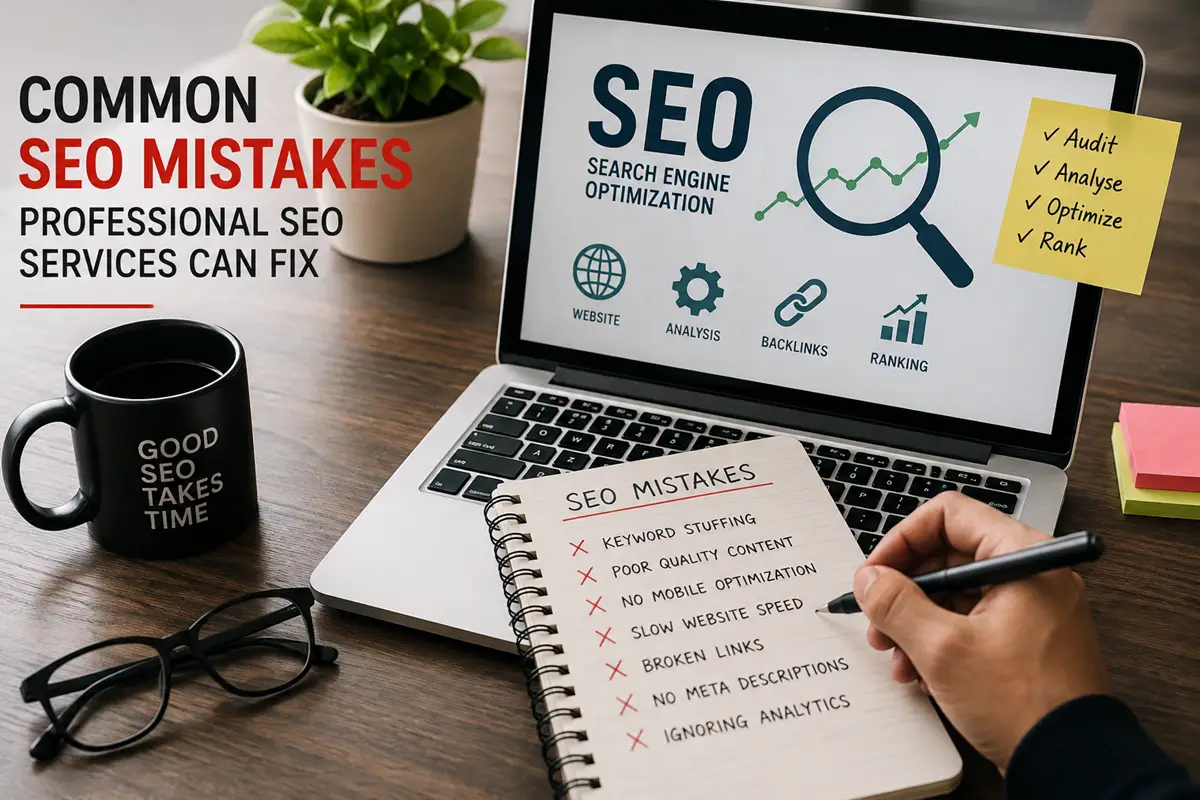
Introduction
The most common SEO mistakes are poor keyword targeting, duplicate content, technical errors, weak internal linking, slow website speed, missed local SEO opportunities, and low-quality backlinks. Professional SEO services fix these issues through a structured audit, keyword mapping, content consolidation, technical improvements, local-listing management, and sustainable link-building, prioritized by business impact rather than guesswork.
Many businesses invest in a website, publish a few blog posts, and add keywords to service pages expecting organic traffic to follow. Sometimes it does. More often, the site remains behind competitors because several small, preventable problems compound over time.
SEO rarely fails for only one reason. A site may have useful content but a weak technical foundation. It may attract visitors but target searches that do not generate leads. It may have strong services but poor internal links, slow load times, or an inconsistent local presence. Below are the seven mistakes professional SEO services identify most often and how they are fixed.
No agency can honestly guarantee a number-one ranking. Search results shift, competitors improve their sites, and search engines ultimately determine visibility. A professional strategy can, however, remove avoidable barriers and make your website more helpful, accessible, and understandable for Google, users, and AI-powered search experiences.
1. Poor Keyword Targeting
The mistake: Targeting keywords that are too broad, too competitive, or disconnected from what potential customers actually search for.
A local plumbing business targeting only “plumber” is competing with national directories, job-related pages, DIY articles, and thousands of other companies. It is also unclear whether the person searching needs an emergency repair, a quote, career information, or a tutorial.
A stronger strategy focuses on searches with clear intent, such as:
- Emergency plumber in [city]
- Water heater repair near me
- Drain cleaning service [location]
- Same-day plumbing repair
- Leaking pipe repair company
These terms may have less search volume than a broad keyword, but they often bring in visitors who are closer to contacting a business.
How it is fixed
Professional SEO services begin by researching the way real customers search. This includes service terms, location-based phrases, problem-focused questions, comparisons, and longer search queries that show a specific need.
They also match the page to intent. Someone searching “how to fix a leaking faucet” may want a DIY solution. Someone searching “same-day faucet repair service” is probably looking for a professional. These two searches need different pages, different content, and different calls to action.
A keyword map is then created so each important page has one clear purpose. Your service page, location page, product category, and informational guide should support one another rather than competing for the same phrase.
The strongest keyword strategy sounds natural. It uses the language customers actually use and avoids repeating a phrase until the content becomes awkward or difficult to read.
2. Duplicate Content Issues
The mistake: Publishing the same or nearly identical content across multiple URLs.
This often happens with city-page templates, e-commerce filters, product variations, tag pages, and service pages created at scale. A business might have 30 location pages where the only real difference is the city name.
That does not create 30 unique assets. It creates a group of similar pages with limited individual value. Search engines may struggle to decide which version deserves to rank, and the pages can end up competing against one another.
Duplicate content can also result from:
- Similar or copied product descriptions
- Repeated blog topics
- URL parameters and filter pages
- Multiple versions of the same URL
- Duplicate titles and meta descriptions
- Old pages that remain live after a site redesign
- City pages with only the location name changed
How it is fixed
SEO specialists audit the site for duplicate titles, similar page copy, repeated metadata, unnecessary category pages, and pages that target the same topic without adding anything new.
Thin location pages may be rewritten with real local value. That could include specific services, areas served, customer concerns, relevant reviews, team details, local projects, or practical information unique to that market.
In other cases, two weak pages may be merged into one stronger resource. If several blog posts answer nearly the same question, combining them can create a more complete guide and reduce internal competition.
Technical solutions may include canonical tags, redirects, and indexing controls. These help search engines understand which version is the primary page and which URLs should not appear independently in results.
A useful rule is simple: if a page does not offer something meaningfully different, it does not need to compete separately in search.
3. Technical SEO Errors
The mistake: Hidden technical issues that make it difficult for search engines to crawl, understand, index, or rank important pages.
A website can look polished to visitors and still have serious technical weaknesses. Important pages may be blocked from indexing, buried in the site structure, linked poorly, or affected by incorrect redirects.
Common technical SEO problems include:
- Broken pages and server errors
- Redirect chains or loops
- Accidental noindex tags
- Missing or misconfigured XML sitemaps
- Incorrect canonical tags
- Duplicate URLs
- Poor URL structure
- Weak mobile usability
- Unclear navigation
- Pages buried too deeply on the site
- Structured-data issues
- Crawl-budget waste on larger websites
Mobile usability is part of SEO
Mobile problems can compound technical issues. Small buttons, unreadable text, layout shifts, intrusive pop-ups, and broken forms make a site frustrating to use. If a customer cannot navigate the page or submit an inquiry easily from a phone, rankings alone will not create results.
How it is fixed
Professional SEO services run a technical SEO audit to see how search engines interact with the website. The review checks crawl paths, indexed pages, sitemap health, redirects, internal links, mobile performance, and structural barriers that may block visibility.
The key is prioritization. Not every technical warning deserves immediate attention, but certain issues can directly cost a site traffic and leads. A blocked service page, slow website templates, crawl errors, and broken conversion forms usually matter more than minor formatting issues.
Google’s SEO Starter Guide also highlights that fundamental SEO improvements can noticeably affect search performance, including making sites accessible and understandable for search engines.
A technically healthy site gives search engines a clean route to important content. It also gives visitors a smoother experience, which supports trust, engagement, and conversions.
4. Weak Internal Linking
The mistake: Publishing useful pages that receive little or no internal support from other pages on the same website.
Internal links connect the pages of your site. They guide visitors toward related information and help search engines understand how pages fit together. When internal links are weak, valuable pages can become isolated and difficult to find.
For example, a guide on “signs you need a new HVAC system” should link naturally to a HVAC installation or replacement service page. A guide about choosing office furniture should link to the relevant product category.
Those links are not filler. They are the logical next step for someone reading the page.
How it is fixed
SEO professionals identify orphan pages, dead-end pages, weak navigation routes, and generic anchor text such as “click here” or “learn more.” These phrases give readers and search engines little context about the page being linked.
They may then organize content into topic clusters. A broad pillar page covers the main subject, while supporting pages answer specific questions and link back to the main topic or appropriate commercial pages.
For example:
- Pillar page: Complete Guide to Commercial HVAC Services
- Supporting page: Signs Your Commercial HVAC System Needs Repair
- Supporting page: Commercial HVAC Maintenance Checklist
- Supporting page: When to Replace a Commercial HVAC Unit
- Service page: Commercial HVAC Repair and Installation
This structure helps people move from research to decision-making without getting lost. It also makes it easier for search engines and AI-powered systems to identify the topics your website covers with depth and authority.
5. Slow Website Speed
The mistake: Allowing pages to load slowly, especially on mobile devices.
Slow pages can drive visitors away before they see an offer, read the content, browse products, or fill out a form. For an e-commerce store, a slow product page or checkout can directly affect sales. For a service business, it can mean a lost phone call or quote request.
Common reasons for poor speed include:
- Large, uncompressed images
- Heavy website themes
- Too many plugins
- Excessive JavaScript
- Third-party chat, tracking, or advertising scripts
- Weak hosting
- Inefficient code
- Large product catalogs
- Complex filtering systems
- Poor caching setup
How it is fixed
A professional SEO provider reviews image formats, JavaScript loading, cache settings, hosting performance, server response time, third-party tools, and page templates.
They also assess Core Web Vitals, which focus on loading performance, visual stability, and interaction responsiveness. A page that shifts while someone tries to click a button or takes too long to respond feels broken, even when it technically loads.
Website speed is not only about technical scores. A faster site can reduce bounce rates, improve browsing, increase page views, and make visitors more likely to contact the business or complete a purchase.
6. Missing Local SEO Opportunities
The mistake: Serving customers in a specific city, neighborhood, or region without clearly and consistently showing that information online.
Local businesses often miss valuable searches because their business details are incomplete, outdated, or inconsistent across directories, map listings, social accounts, and the website itself.
Common local SEO issues include:
- Different business names, addresses, or phone numbers across platforms
- Incorrect business hours
- Incomplete business profiles
- Missing or wrong categories
- Weak location pages
- Very few customer reviews
- Unanswered feedback
- Generic city pages with copied content
- No clear service-area information
- Missing local citations
How it is fixed
Professional SEO services review and correct business information across relevant listing platforms. They help maintain consistency so potential customers and search engines receive the same information everywhere.
They can also create useful location pages. A strong page should explain the services offered in that area, the neighborhoods served, what customers can expect, and how to contact the business. It should not merely replace one city name with another.
Review management can also be part of the strategy. Businesses should encourage genuine feedback from customers and respond professionally to both positive and negative reviews. A strong review profile helps potential customers feel more confident about choosing your company.
Local searchers often have immediate intent. A person searching “roof repair near me,” “emergency dentist in [city],” or “same-day locksmith” may need help now. Understanding why local SEO is critical for Ghanaian businesses can help local companies build stronger visibility when that need is urgent.
7. Low-Quality Backlinks
The mistake: Believing that more backlinks automatically lead to better rankings.
Backlinks are links from other websites to your own. They can help build credibility, but only when they are relevant, trustworthy, and acquired naturally. Chasing large volumes of low-quality links through spam directories, automated networks, or paid schemes rarely creates lasting value.
Low-quality backlinks may come from:
- Spam directories
- Private blog networks
- Automated link schemes
- Irrelevant websites
- Low-value guest-post farms
- Paid link packages
- Comment spam
- Scraped-content sites
These tactics can create the appearance of SEO activity, but they do not build genuine authority. In some cases, they can create long-term risk.
How it is fixed
Professional SEO services audit the existing backlink profile to identify useful links, questionable patterns, and potential opportunities. They also examine competitor profiles to understand where competitors are earning legitimate mentions.
The goal is to earn links through actual value, such as:
- Original research or useful data
- Helpful industry resources
- Expert commentary
- Digital PR
- Local sponsorships
- Community involvement
- Supplier and partner relationships
- Product reviews
- Strong editorial content
A healthy backlink profile does not need thousands of links. It needs the right references from sources that make sense for your industry, location, and audience.
How Professional SEO Services Solve These Problems
Professional SEO is not a random list of tasks. It is an ordered process based on what will have the greatest impact on business results.
1. Audit
The first step is a complete review of the site. This often includes:
- Technical SEO analysis
- Keyword research
- Content audit
- Internal-linking review
- Backlink analysis
- Local SEO evaluation
- Competitor research
- Conversion and user-experience review
The goal is to identify what is preventing the website from performing before investing in broad content or link-building campaigns.
2. Prioritize
Not every problem should be solved at the same time. A good SEO provider focuses first on critical issues, such as blocked pages, major crawl errors, slow speed, broken conversion paths, or poorly optimized core service pages.
Once the foundation is stable, the work can expand into content improvements, stronger internal links, local search visibility, and authority-building opportunities. For growing companies without an in-house specialist, understanding the benefits of outsourcing SEO can help determine the right approach.
3. Measure
Rankings are useful, but they are not the only measure of success. Professional SEO services should also track:
- Organic traffic
- Qualified leads
- Form submissions
- Phone calls
- Booked appointments
- Sales
- Local visibility
- Conversion rate
- Performance of high-value pages
For visibility in Google and AI-powered answer platforms, clarity matters more than ever. Google recommends people-first content that is useful to a real audience, demonstrates expertise, and provides a satisfying answer instead of being created primarily to manipulate search rankings.
Your website should clearly answer:
- Who are you?
- What do you offer?
- Who do you serve?
- Where do you operate?
- Why should someone trust you?
- What should a visitor do next?
Use straightforward headings, direct answers, helpful FAQs, original examples, and clear service information. Avoid vague claims, keyword stuffing, and thin pages that exist only to capture search traffic.
Frequently Asked Questions
What is the most common SEO mistake small businesses make?
Poor keyword targeting is one of the most common issues. Businesses often chase broad, high-competition keywords instead of specific, intent-driven searches that match what customers actually type. A focused strategy shows how SEO services help small businesses get more leads from relevant searches.
Can duplicate content hurt SEO?
Duplicate content does not always lead to a direct penalty. However, it can make it harder for search engines to identify the best page to rank. Similar pages may compete with one another and weaken overall visibility.
How long does it take to fix technical SEO issues?
It depends on the site size and the seriousness of the problem. Critical issues, such as blocked pages, broken redirects, or indexing errors, may be fixed within days or weeks. Larger structural improvements can take longer.
Can I fix SEO problems myself?
Some basic changes can be handled internally, including improving page titles, updating business information, and correcting obvious content gaps. Professional help is especially valuable when technical, content, local, and authority issues overlap.
Can SEO help my website appear in AI search results?
No one can guarantee that an AI tool will cite or recommend a particular website. However, original, accurate, well-structured, people-first content with clear headings and strong technical foundations gives search systems better information to understand and potentially surface. Google specifically recommends content that serves people first and provides substantial value beyond what already exists.
Conclusion
Common SEO mistakes quietly limit a website’s potential. Poor keyword targeting attracts the wrong visitors. Duplicate content creates confusion. Technical errors reduce crawlability and visibility. Weak internal links hide valuable pages. Slow speed frustrates customers, while missed local opportunities and low-quality backlinks weaken trust.
The good news is that these problems are fixable. Professional SEO services identify what is holding the site back, create a practical plan, and improve the areas that matter most for organic traffic, leads, sales, and long-term growth.
SEO is not a one-time task or a shortcut to instant rankings. It is an ongoing process of making your website clearer, more useful, easier to navigate, and easier for the right customers to trust. If you want to identify the issues affecting your website, request a free SEO audit or contact our team for professional support.