
 Local SEO Strategy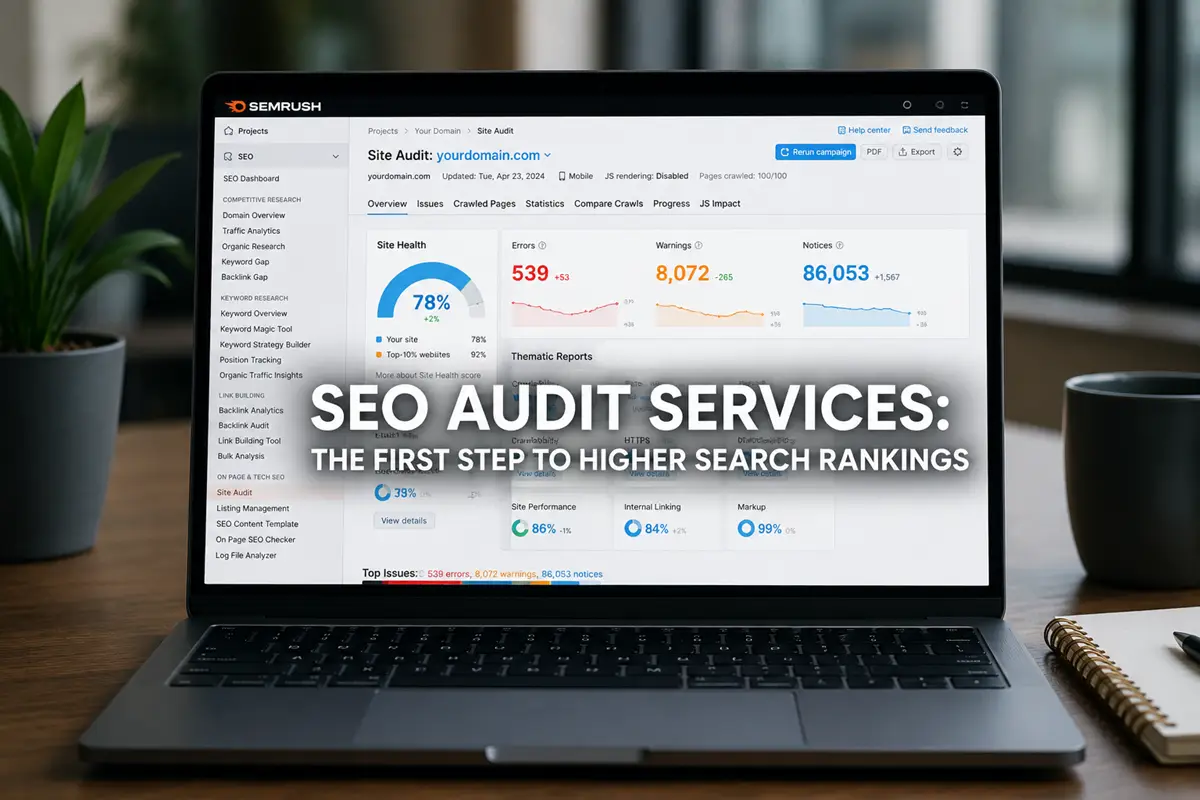
Introduction
Many businesses invest time and money into content, website design, paid advertising, and social media, yet still struggle to gain visibility in search results. The problem is not always a lack of effort. Sometimes the website has underlying issues that make it harder for search engines to understand, crawl, or trust the site.
That is where SEO audit services come in. An SEO audit is a detailed review of your website’s search performance, technical health, content quality, and competitive position. It helps uncover the obstacles that may be limiting rankings, traffic, leads, and sales.
Think of it as a full health check for your website. Before making major changes, you need to know what is working, what is broken, and where the best opportunities are. Without that clarity, SEO can turn into guesswork. You may publish more content, add more keywords, or redesign pages without addressing the real reason your site is underperforming.
A professional SEO audit gives you a roadmap. It shows which problems deserve immediate attention, which improvements can create the strongest results, and how your website compares with competitors already ranking for the searches that matter to your business.
What Is an SEO Audit?
An SEO audit is a structured evaluation of the factors that affect a website’s ability to rank in search engines. It looks beyond a single page or keyword and examines how the entire website performs from a search perspective.
The audit usually covers technical SEO, on-page optimization, content quality, backlinks, site architecture, indexing, mobile usability, page speed, internal linking, and competitor visibility. The purpose is to identify both weaknesses and opportunities.
For example, a business may have helpful service pages but poor internal linking, making those pages difficult for search engines to discover. Another website may have strong content but slow loading times that drive visitors away. A different company may rank for useful keywords but fail to convert visitors because the pages are unclear or outdated.
An audit brings these issues together in one place. Rather than looking at rankings as an isolated number, it explains the reasons behind performance. This is important because high search rankings do not come from one tactic. They usually come from a combination of strong content, technical health, relevance, authority, and user experience.
The best audits do not simply generate a long list of errors. They prioritize the findings. A business owner should leave with a practical plan, not a document full of technical terms that never gets used.
Technical SEO Audit
A technical SEO audit focuses on the behind-the-scenes parts of your website. These elements are not always visible to visitors, but they strongly influence whether search engines can access, understand, and index your pages properly.
One of the first things an audit checks is crawlability. Search engines use automated systems to discover pages and follow links across a website. If important pages are blocked, buried too deeply in the site structure, or linked poorly, they may not be crawled effectively. That can prevent valuable content from appearing in search results.
Indexing is another important area. A page can exist on your website but still not be included in search results if it is incorrectly marked, duplicated, blocked, or treated as low value. An audit helps identify pages that should be indexed but are not, as well as pages that should not be competing for search visibility.
Site speed is also reviewed. Slow-loading pages can frustrate visitors and reduce the chance that they will stay, explore, or convert. Common causes include oversized images, inefficient code, unnecessary scripts, weak hosting, too many plugins, or poorly optimized themes. A technical audit identifies where these performance issues are coming from.
Mobile usability is equally important. Many people search, browse, and buy from mobile devices, so a website needs to work smoothly on smaller screens. An audit may identify text that is difficult to read, buttons that are hard to tap, pages that shift while loading, or layouts that do not respond properly on phones.
Other technical checks often include:
- Broken links and missing pages
- Redirect chains and loops
- Duplicate URLs
- XML sitemap issues
- Canonical tag errors
- Structured data problems
- HTTPS and security checks
- Internal-linking weaknesses
- URL structure problems
- Crawl-budget concerns for larger websites
Technical SEO can feel less exciting than content creation, but it provides the foundation for everything else. If search engines cannot crawl or understand your site, even excellent content may struggle to perform. Regular technical improvements are a central part of monthly SEO services that support long-term growth.
On-Page SEO Audit
An on-page SEO audit looks at the individual pages on your site and evaluates how well they match the searches you want to rank for. This includes page titles, headings, meta descriptions, internal links, copy, images, calls to action, and overall page structure.
One common problem is unclear keyword targeting. A page may cover too many topics at once or use vague language that does not match what potential customers are actually searching for. An audit helps determine whether each page has a clear purpose and whether it is aligned with the right search intent.
For example, a page targeting “emergency plumbing services” should immediately explain the service, the locations served, the response process, and how someone can get help. If the page instead contains general information about plumbing with no clear next step, it may not meet the searcher’s needs.
Title tags and headings are also reviewed. These elements help search engines and users understand what a page is about. They should be clear, relevant, and naturally written. Overloading them with repeated phrases rarely helps. Strong on-page optimization focuses on clarity rather than trying to force the same term into every sentence.
An audit may also look at whether pages have enough useful information. Thin pages often struggle because they do not answer the customer’s real questions. A service page may need better explanations, FAQs, pricing guidance, process details, proof of experience, testimonials, or local service information.
Internal links are another important part of on-page SEO. A well-organized website guides visitors from one useful page to another. It also helps search engines understand which pages are most important. If key service or product pages receive little internal support, they may be harder to rank.
The goal of an on-page audit is not to add more words for the sake of it. It is to make each page more useful, more focused, and more aligned with the needs of the person searching.
Content Audit
A content audit reviews the pages, articles, guides, product descriptions, FAQs, and other written materials on your website. It helps determine whether your content is helping the site grow or simply taking up space.
Over time, most websites build up content that becomes outdated, repetitive, or less useful than it once was. A blog post written several years ago may no longer reflect current products, customer questions, or industry practices. A service page may be too short to compete. Several articles may target the same topic and end up competing with one another.
A content audit helps organize this situation. Each piece of content can be classified according to its value and performance. Some pages may need updating, some may need to be expanded, some may be merged, and some may no longer serve a purpose.
The process often looks at:
- Organic traffic and search visibility
- Keyword relevance
- Content freshness
- Search intent alignment
- Engagement and conversion potential
- Duplicate or overlapping topics
- Internal linking opportunities
- Missing content in the customer journey
- Accuracy and usefulness of the information
A good content audit also reveals gaps. Perhaps customers are searching for comparison guides, pricing information, troubleshooting advice, or local SEO information for Ghanaian businesses that your website does not cover. Those gaps can become valuable opportunities for new content.
For example, an HVAC business may have pages for installation and repair but no content explaining when a homeowner should repair a system versus replace it. A useful guide on that topic could attract early-stage search traffic and lead naturally toward a service inquiry.
Content should not be created simply because a website “needs more blog posts.” The strongest content is created to answer meaningful questions, support business goals, and help users make decisions.
Backlink Audit
A backlink audit examines the websites that link to your domain. Backlinks can help build authority because they act as references from other websites. But not all links have the same value.
A quality backlink profile is usually made up of relevant, credible, naturally earned links from websites connected to your industry, location, customers, or expertise. These might come from local news sites, industry publications, business partners, professional associations, useful resource pages, or editorial coverage.
An audit looks at both the strength and the risk of your existing link profile. It may identify useful links that support authority, weak links that add little value, and suspicious links that appear unnatural or spam-related.
The purpose is not to obsess over every individual link. It is to understand the overall pattern. Does your website have links from relevant sources? Are competitors earning references from publications or industry websites where you are absent? Are important pages receiving links, or is all authority concentrated on the homepage?
A backlink audit can also identify missed opportunities. If competitors are consistently earning local mentions, industry citations, product reviews, or editorial links, that may point to practical outreach opportunities for your own business.
Quality matters far more than quantity. A small number of strong, relevant links can be more valuable than hundreds of random links from unrelated websites. Any SEO provider that focuses only on high link volume without discussing relevance and quality should be approached carefully.
Competitor Audit
A competitor audit helps you understand who is winning visibility in your market and why. Your search competitors are not always the same as your traditional business competitors. A company may be smaller than you in the real world but still outperform you online because its website is more focused, faster, or better aligned with search demand.
The audit usually begins by identifying the websites that rank for the keywords and topics most important to your business. From there, it compares their content, technical setup, page structure, local visibility, backlinks, and user experience with your own website.
This does not mean copying competitors. The goal is to understand the gap and find ways to create a stronger version of what searchers need.
For example, a competitor may rank because it has detailed service pages for each location, helpful answers to common questions, strong reviews, and clear internal links. Another may be winning because it has built authority through industry coverage and useful resources. Once you understand the reasons, you can build a strategy around the opportunities that make sense for your business.
A good competitor audit may reveal:
- Keywords competitors rank for that you do not
- Content topics you have not covered
- Pages that are more detailed or better structured than yours
- Local SEO signals competitors are using effectively
- Backlink opportunities in your industry or area
- Weak competitor pages that you can improve upon
- Conversion elements that make their pages more persuasive
The goal is not to chase every competitor move. It is to identify the areas where your business can realistically become more useful, more visible, and more credible.
Implementing Audit Findings
An SEO audit is only valuable if the findings lead to action. A long report can be useful, but it should ultimately turn into a prioritized plan that your team or SEO provider can implement.
The first priority is usually fixing issues that block search performance. These may include pages that cannot be indexed, major crawl errors, slow load times, broken internal links, mobile usability problems, or technical mistakes affecting important pages.
The next stage often focuses on high-value pages. These are the pages most likely to generate leads, sales, bookings, or inquiries. They may include core service pages, product categories, local landing pages, pricing pages, or key informational resources. Improving these pages can often create more immediate business value than trying to optimize every page at once.
Content improvements usually follow. This may involve refreshing outdated content, expanding thin pages, merging overlapping articles, creating missing resources, and strengthening internal links. The goal is to improve the usefulness and organization of the website over time. For businesses without dedicated in-house expertise, outsourcing SEO for a growing business can help keep this work consistent.
Link-building and authority work may also be part of the plan, especially if competitors have a stronger online reputation. This should focus on earning legitimate mentions through useful content, local involvement, partnerships, digital PR, or industry relationships.
Implementation should be measured in stages. Rather than changing everything at once, a good SEO plan tracks progress and adjusts based on what is working. Rankings, organic traffic, calls, forms, sales, and engagement can all help show whether the changes are moving the site in the right direction. This is also how a well-planned SEO strategy can support more qualified leads for small businesses.
An audit is not a magic solution by itself. It is the starting point for smarter SEO. The value comes from using the findings to make focused, ongoing improvements.
Conclusion
SEO audit services are often the first step toward higher search rankings because they reveal what is really happening beneath the surface of your website. They identify technical problems, content gaps, weak on-page optimization, backlink concerns, and competitive opportunities that may otherwise go unnoticed.
Without an audit, SEO can become a cycle of random updates and guesswork. With an audit, your business gets a clearer picture of what to fix, what to improve, and where to invest effort first. This is one of the main reasons businesses need professional SEO services to support sustainable online growth.
The strongest websites are not necessarily the ones with the most pages or the biggest budgets. They are the ones that are technically sound, useful to visitors, easy for search engines to understand, and consistently improved over time.
If your website is not getting the traffic, leads, or rankings you expect, request a free SEO audit to identify the issues affecting performance and create a practical path forward. If you need help applying the recommendations, contact our SEO team.