
 Local SEO Strategy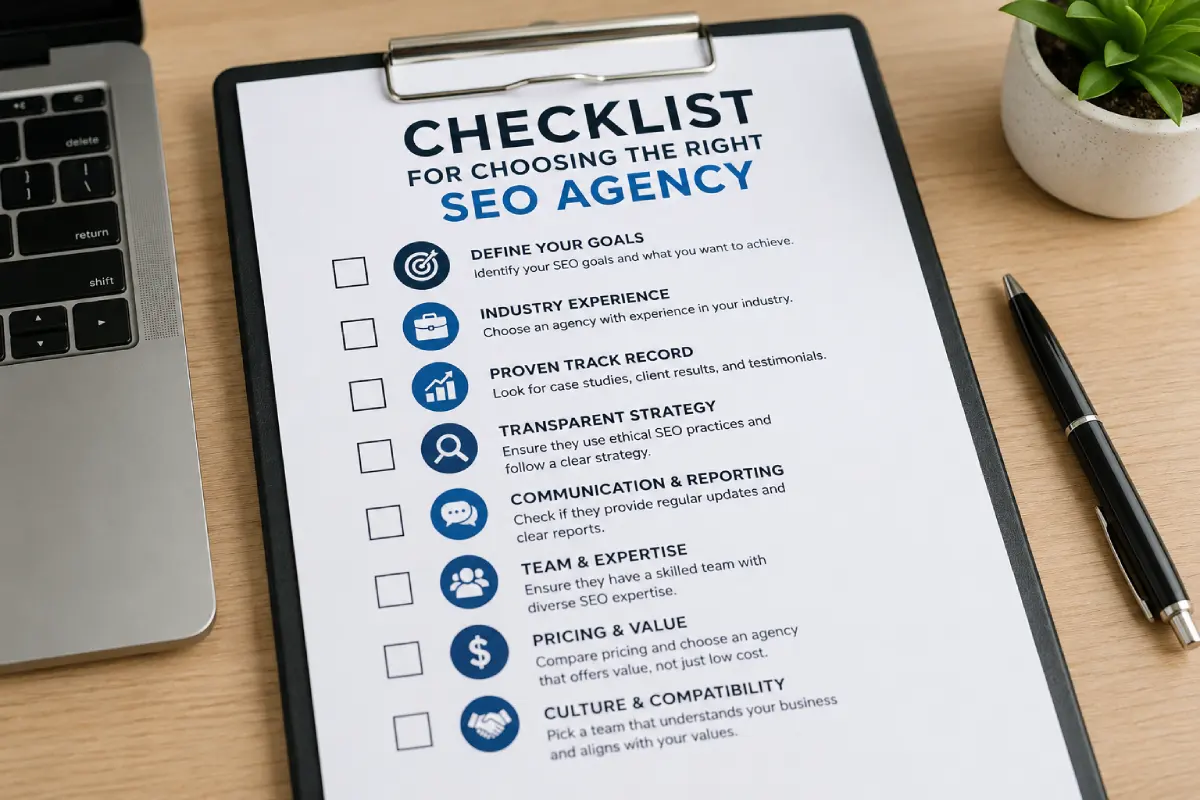
Introduction
Choosing an SEO agency can feel a little like hiring for a role you do not fully understand. You know the outcome you want: more visibility, better traffic, and more leads, but it is not always easy to tell which agency can actually deliver that result. Some sound polished in the sales call and still disappoint once the work begins.
That is why the selection process matters so much. A strong SEO agency should not just promise rankings. It should understand your business, explain its approach clearly, and show how its work connects to real growth. If you are still defining what that growth should look like, why your business needs SEO services is a useful place to start.
The goal of this checklist is to help you make a smarter decision. Instead of focusing on vague promises or flashy presentations, you will know what to look for, what questions to ask, and what signs suggest an agency is the right fit. That way, you can choose a partner that supports your long-term goals rather than adding more confusion.
Define Your SEO Goals
Before you compare agencies, you need to know what you want SEO to do for your business. That might sound obvious, but many businesses start shopping for an agency without a clear goal. When that happens, it becomes much harder to evaluate whether the agency is actually helping.
Your SEO goals may look different depending on your business model. A local service business may want more phone calls and quote requests. An e-commerce store may want more product visibility and sales. A B2B company may care more about lead quality and form submissions. Each of those goals requires a slightly different strategy.
It also helps to define what success means in practical terms. Do you want more organic traffic, stronger rankings for specific pages, better local visibility, or a higher conversion rate? The more specific you are, the easier it becomes to judge whether an agency is a good match.
A good agency should ask about your goals early in the conversation. If they jump straight into packages or rankings without understanding your business, that is usually a warning sign. SEO should support your objectives, not replace them.
Check Agency Experience
Experience matters, but not all experience is equal. An agency may have been in business for years and still not be the right fit for your needs. What matters more is whether they have experience with businesses similar to yours and with the kind of SEO work your site actually needs.
If you run a local business, you want an agency that understands local search behavior, map visibility, citations, and service-area targeting. If you operate an e-commerce store, you want someone who knows product page optimization, category structure, and technical site management. If you are in a competitive niche, you need an agency that can handle deeper strategy and long-term competition.
It is also worth asking who will actually do the work. Some agencies sell from a polished front end but outsource most of the execution without much oversight. That is not always bad on its own, but you should know who is responsible for strategy, content, technical fixes, and reporting.
Experience should show up in the way an agency talks about SEO. They should be able to explain priorities in plain language and connect tactics to outcomes. If the conversation stays too generic, that may mean their experience is broad but not especially relevant. For a clearer benchmark, see what to expect from professional SEO services.
Review Case Studies
Case studies are one of the best ways to see how an agency thinks. A strong case study should show the problem, the approach, and the result. It should not just list rankings or traffic gains without context. You want to understand how the agency solved a real business challenge.
Look for case studies that resemble your situation. If the agency only shows examples from large national brands but you run a local business, the results may not translate. Similarity matters because SEO strategies can vary a lot depending on industry, market size, and website structure.
Pay attention to the details in the case studies. Did the agency improve technical performance, rewrite content, refine keyword targeting, or build stronger local visibility? Did the work lead to more leads, more sales, or better-qualified traffic? Good case studies connect the SEO work to a meaningful business outcome.
It is also useful to notice how transparent the agency is about the process. If the case study is vague, overly polished, or full of buzzwords, it may not be very useful. Strong agencies are usually specific because they understand that real results do not need exaggeration. If your business depends on leads, it may also help to review how SEO services help small businesses get more leads.
Understand Their SEO Process
A reliable SEO agency should be able to explain its process clearly. You do not need a technical lecture, but you do need enough detail to understand how the work will be organized and why it matters. If the process sounds random or overly secretive, that is a concern.
A good SEO process usually starts with an audit. The agency should review your site’s technical health, content quality, keyword visibility, and competitive position. That audit creates the foundation for the strategy. Without it, the plan is likely to be based on assumptions rather than evidence.
Next, the agency should explain how it handles keyword research, content planning, on-page optimization, technical fixes, and link building. Each of those pieces should fit together. SEO works best when it is structured, not when tasks are done in isolation. If you want to see a full service approach laid out clearly, SEO services pages often show the components a strong provider should cover.
You should also ask how often the process is reviewed and adjusted. Search behavior changes, competitors move, and search engines update their systems. A strong agency does not just set a plan and disappear. It checks performance, updates priorities, and keeps improving the strategy over time.
Evaluate Communication Practices
Communication can make or break the relationship with an SEO agency. Even a capable team can become frustrating if they do not keep you informed or make it hard to understand what is happening. Good SEO should feel like a partnership, not a mystery.
Ask how often you will receive updates and what those updates will include. Will you get monthly reports? Regular check-ins? Access to an account manager? Knowing this ahead of time helps you understand whether the agency’s communication style matches your expectations.
It is also important to see how clearly they explain their work. A trustworthy agency should be able to talk about rankings, traffic, conversions, and technical issues in simple language. You should not feel like you need to decode every answer. Clarity is a sign that they understand what they are doing.
Pay attention to how they respond before you sign. Do they answer your questions directly? Do they take time to understand your business? Do they communicate in a way that feels organized and consistent? Those habits often carry over into the actual working relationship. If you are uncertain about warning signs, 10 clear signs you need professional SEO services can help you spot them early.
Analyze Pricing Structure
Pricing can be one of the trickiest parts of choosing an SEO agency. The cheapest option is not always the worst, and the most expensive option is not always the best. What matters most is whether the price matches the value and the scope of work.
Start by understanding exactly what is included. Some agencies offer a low monthly fee but provide very limited work. Others may charge more because they include strategy, content support, technical optimization, and reporting. Comparing agencies only by price can be misleading if the scope is very different.
It is also important to ask how the pricing model works. Is it a flat monthly retainer, a one-time project, or hourly consulting? Each model has pros and cons. Monthly retainers are common because SEO is ongoing, but project-based work may make sense if you need help with a specific issue or site improvement.
Be cautious if an agency cannot explain why its pricing is structured the way it is. Good agencies should be able to tell you what drives the cost and what kind of work is included. If pricing feels vague, the service may be vague too. For budget-minded buyers, comparing against affordable SEO services can make pricing conversations more practical.
Verify Reporting Methods
If you cannot measure the work, it becomes much harder to know whether SEO is helping. That is why reporting is a critical part of the agency selection process. A good agency should show you how it tracks progress and how it connects SEO activity to business outcomes.
Ask what metrics they report on. Rankings are useful, but they should not be the only metric. You also want to see organic traffic, conversions, leads, click-through rates, and any other numbers that reflect real business growth. The best reporting focuses on impact, not just activity.
It also helps to understand how often reporting happens and how it is presented. A monthly report is common, but the format matters. You want something that is easy to read, clearly explained, and tied to the goals you set at the beginning. A stack of charts without interpretation is not very helpful.
A strong agency should also use reporting to guide decisions. If a page is performing well, they should explain why. If a campaign is underperforming, they should explain what needs to change. Reporting should create clarity, not just document the past. If you want to start with a low-risk evaluation, a free audit can help you see how transparent a provider really is.
Questions to Ask Before Signing
Before you sign with an agency, ask a few direct questions. The answers can tell you a lot about whether they are the right partner. You are not just buying SEO work; you are entering a business relationship.
Ask what the first 90 days will look like. A good agency should be able to explain the initial audit, early priorities, and the kind of improvements you can expect. This gives you a sense of whether they have a real plan or just a sales pitch.
Ask how they handle content. Will they create it, optimize it, or provide recommendations for your team? Content often plays a huge role in SEO, so you need to know where that responsibility sits. The same applies to technical work and link building.
You should also ask how they define success. If the answer is only “better rankings,” that may not be enough. Rankings are useful, but the real goal is business growth. The agency should understand that difference and speak to it clearly.
Finally, ask what happens if something is not working. A strong agency should have a process for reviewing performance and making adjustments. SEO is not static, and a good partner should be willing to adapt rather than repeat the same actions indefinitely. If local visibility is part of your plan, you may also want to review local SEO services that help businesses dominate search in their area.
Conclusion
Choosing the right SEO agency takes more than comparing price tags or scanning polished websites. It requires a clear understanding of your goals, a close look at the agency’s experience, a review of real case studies, and a serious conversation about process, communication, pricing, and reporting.
When you take the time to evaluate those areas carefully, you are much more likely to find a partner who can actually help your business grow. The right agency should feel transparent, strategic, and focused on results that matter to you. That kind of fit is worth the effort.
SEO works best when it is handled by a team that understands both search and business. Use this checklist to narrow your options, ask better questions, and choose an agency that can support your goals with clarity and confidence.