
 Local SEO Strategy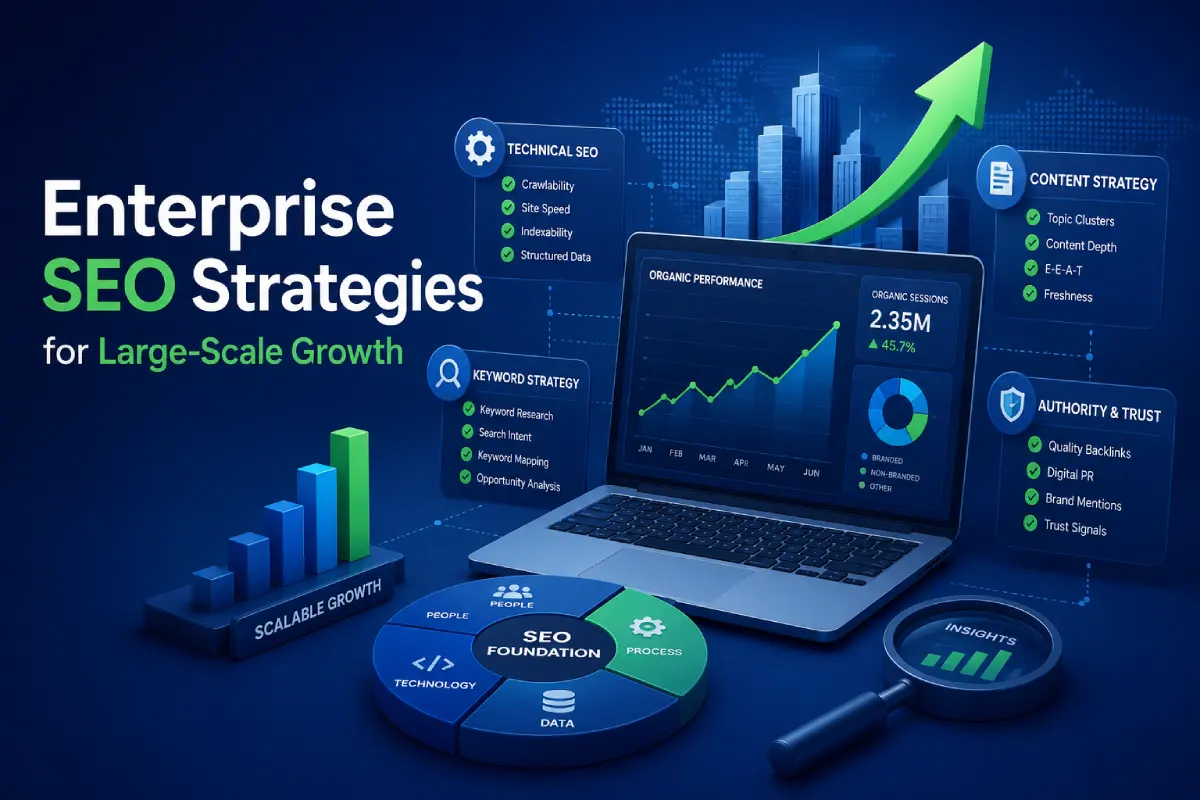
Introduction
Enterprise SEO is a different game from small business SEO. When a company has hundreds or thousands of pages, multiple departments, several product lines, or even international markets, the search strategy has to work at a much larger level. A small mistake can affect a huge number of pages, and a strong decision can create meaningful growth across the entire business.
That is why enterprise SEO services are so valuable. They help large organizations manage complexity, improve visibility across important sections of the site, and build a search strategy that supports long-term growth. At this scale, SEO is not just about ranking a few pages. It is about creating a system that can support performance across a large digital footprint. For a broader view of the role SEO plays in business growth, see why your business needs SEO services.
For enterprise businesses, SEO also has to fit into broader goals. It should work alongside brand strategy, product marketing, sales, international expansion, and user experience. The challenge is not only doing SEO well, but doing it in a way that can be repeated, tracked, and scaled across the business.
What Is Enterprise SEO?
Enterprise SEO is the process of optimizing large websites so they can perform well in search at scale. It involves the same core principles as standard SEO, but the execution is more complex because the site usually has more pages, more stakeholders, and more moving parts.
A large company may need to manage category pages, product pages, service pages, blog content, resource centers, location pages, and international pages all at once. Each of those areas may need its own keyword strategy, technical setup, and content plan. That is where enterprise SEO becomes more strategic than tactical.
The goal is to make sure the most important pages are visible, the site remains technically healthy, and search performance supports the business as a whole. On a large site, even small improvements can have an outsized impact because they affect so many pages and users.
Enterprise SEO also tends to involve collaboration across teams. SEO professionals may work with developers, content teams, designers, product managers, and leadership. That collaboration is important because changes at this level often depend on internal coordination, not just optimization skill. If you are comparing service models, what to expect from professional SEO services can help set realistic expectations.
Challenges of Enterprise Websites
Large websites come with large challenges. One of the biggest is scale itself. When a site contains thousands of URLs, it becomes harder to keep everything organized, consistent, and optimized. Problems that would be minor on a small site can become major on an enterprise platform.
Duplicate content is a common issue. Large companies often publish similar pages for different regions, products, or departments. If those pages are not managed carefully, they can compete with each other or dilute search performance. Search engines may also struggle to understand which version should rank.
Another challenge is site complexity. Enterprise websites often have complicated navigation, layered filters, legacy pages, and multiple templates. That can create crawl issues, indexing problems, and poor user experiences if the site architecture is not carefully maintained. A site this large needs clear structure and ongoing oversight.
Internal communication can also be a barrier. In many organizations, SEO recommendations need approval from several teams before they can be implemented. That can slow things down unless the process is well managed. Enterprise SEO often succeeds or fails based on how well it is integrated into the company’s workflow.
Enterprise Keyword Strategy
Keyword strategy at the enterprise level has to be broader and more organized than on a smaller site. There are usually more pages to optimize, more categories to cover, and more search opportunities to map out. The goal is to make sure each important page has a clear role in the overall search strategy.
A strong enterprise keyword plan usually starts with understanding the site’s structure. Which sections are meant to attract informational traffic? Which pages are meant to drive conversions? Which areas support products, services, locations, or thought leadership? Once that framework is clear, keyword targeting becomes much more effective.
It is also important to avoid overlap. On a large website, multiple pages can accidentally target the same term and weaken each other. A good strategy assigns keywords carefully so that each page has a distinct purpose. That makes it easier for search engines to understand page relevance and for users to find the content they need.
Enterprise keyword strategy should also reflect business priorities. Some pages may target high-volume terms, while others may focus on lower-volume but high-value searches. The right mix depends on the organization’s goals, industry, and customer journey. A large business usually needs both visibility and precision.
Technical SEO at Scale
Technical SEO becomes especially important on enterprise websites because the site is too large to rely on manual checks alone. Small issues can spread quickly and affect many pages. If the site architecture is weak or the technical foundation is unstable, search performance can suffer across the board.
Crawl efficiency is one of the first things to consider. Search engines need to find and process important pages without wasting time on low-value or duplicate URLs. On a large website, controlling crawl paths, internal linking, redirects, and indexation rules is essential. Otherwise, search engines may spend too much energy on the wrong pages.
Page speed and performance also matter. A slow or overloaded site can create problems for both users and search engines. At enterprise scale, this often requires coordination with development and infrastructure teams. Technical SEO is not just about identifying issues; it is about making sure the fixes are implemented correctly and consistently.
Structured data, canonical tags, XML sitemaps, pagination, and faceted navigation can also become major concerns. These elements help search engines interpret the site correctly. If they are mismanaged, they can create confusion, duplication, or missed opportunities. Enterprise SEO requires constant attention to these details because the site is always changing.
Content Management for Large Websites
Content management is one of the hardest parts of enterprise SEO because large sites often publish a lot of content across different teams. Without a clear system, pages can become inconsistent in tone, quality, and optimization. That can weaken search performance and make the brand feel scattered.
A strong content process starts with governance. Large organizations need clear rules for how content is created, reviewed, updated, and retired. That includes deciding who owns each type of page and what standards should be followed. When content is managed well, the entire site becomes easier to maintain.
Freshness is another major issue. Enterprise websites often have valuable pages that go stale over time. Product details change, service offerings evolve, and older content may stop reflecting current customer needs. Regular content updates help keep the site accurate, relevant, and competitive. For businesses balancing this work with leaner internal teams, outsourcing SEO for growing businesses can be a practical option.
Content also needs to be scalable without becoming generic. At enterprise level, it is tempting to produce content quickly and in large batches. But search engines and users both respond better to pages that offer genuine value. The best enterprise content systems are efficient, but they still preserve quality and originality.
International SEO Considerations
For global companies, international SEO adds another layer of complexity. A business may need to serve different countries, languages, and regional search behaviors, all while maintaining a consistent brand. That requires careful planning from the start.
One of the biggest issues is localization. A direct translation is not always enough because search behavior, terminology, and buying habits can vary from one market to another. Enterprise SEO needs to account for those differences so each version of the site feels relevant to the local audience.
Technical setup is also important. International websites often need the right structure for language and region targeting so search engines can understand which version to show in which market. If this is handled poorly, users may land on the wrong version of the site or see content that does not fit their location.
International SEO also has to balance global consistency with local flexibility. The brand should stay recognizable, but each market may need its own messaging, keyword focus, or content depth. Large businesses that expand internationally usually need a strategy that respects both search engines and local users.
Performance Tracking
At enterprise scale, SEO performance must be measured carefully. A large site may have many different page types, traffic sources, and conversion paths, so it is not enough to look at one or two metrics. The reporting system needs to show what is working across the business.
Organic traffic, rankings, conversions, and revenue-related metrics are important, but so are page-level trends and sitewide patterns. A strong enterprise SEO program usually tracks performance by section, page type, keyword group, or market. That makes it easier to see where gains are happening and where improvement is needed.
It is also important to measure leading indicators, not just final results. Technical health, crawl performance, indexation levels, content updates, and page engagement can all show whether the strategy is moving in the right direction before revenue changes become visible. Those signals are especially useful in large organizations where SEO work may take time to influence business outcomes.
Reporting should be built for decision-making. Enterprise teams need to know what actions to take, what risks exist, and which areas deserve more attention. Good tracking turns SEO from a reporting exercise into a business tool. If a team needs a broader service framework, SEO services can provide the structure needed to support that scale.
Conclusion
Enterprise SEO services help large businesses manage complexity and turn search visibility into large-scale growth. At this level, success depends on more than rankings. It depends on structure, coordination, technical health, content management, and a strategy that can scale across many pages and teams.
The challenges are real, but so is the opportunity. When enterprise SEO is handled well, it can improve visibility across key sections of the site, support international growth, strengthen content performance, and create a more reliable search foundation for the entire business.
For large organizations, SEO is not just a marketing channel. It is part of the digital infrastructure that supports long-term growth, discoverability, and competitive strength. When there are signs the current setup is underperforming, 10 clear signs you need professional SEO services can help identify the warning signs early.
If the goal is to improve lead generation at scale, how SEO services help businesses get more leads is also worth reviewing. And for location-driven growth, local SEO services can help strengthen visibility in specific markets.
For teams evaluating next steps, a free audit can be a useful starting point for identifying priorities and opportunities.